EnglishClass 7

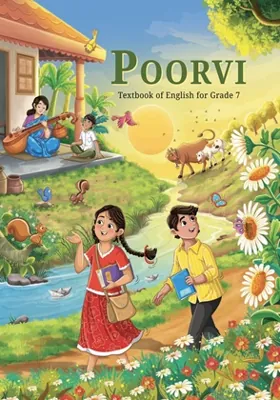
Poorvi

English Textbook (New)5 Chapters

Chapter notes

What you'll learn in Poorvi

A quick revision map of Poorvi — the core idea and five key takeaways from each chapter. Tap any chapter to read the full NCERT PDF and detailed notes.

01

Unit 1: Learning Together

Unit 1 of NCERT Class 7 English (Poorvi), "Learning Together", is a thematic unit that bundles three texts around the shared theme of perseverance, curiosity, and the value of education. It opens with the story "The Day the River Spoke" by Kamala Nair, in which a young coastal girl named Jahnavi gains the courage to attend school through an imaginary conversation with a personified river. The second text is the narrative poem "Try Again" by Eliza Cook, which retells the legend of King Bruce of Scotland finding renewed determination by watching a spider make nine attempts to reach its cobweb. The unit closes with an excerpt from "Three Days to See" by Helen Keller, in which the author — who is blind — imagines how she would spend three days if given the gift of sight, and urges sighted readers to cherish every sense as if it might be lost tomorrow.

  • 1"The Day the River Spoke" is set in a coastal village in India; Jahnavi is nearly ten years old and has been kept from school to care for younger brothers Ramu and little Appu while her siblings Gopi (called 'Ettan', meaning Elder Brother) and Meena attend school.
  • 2The River, personified as a sleepy, murmuring voice, tells Jahnavi that 'little girls can do as much as little boys' and advises her to simply slip into school one morning and listen.
  • 3Jahnavi gathers courage, creeps into the back row of the classroom carrying little Appu, and the teacher promises to speak to her father — which results in her parents giving permission for her to attend school.
  • 4Jahnavi resolves that when she grows up she will become a teacher and go from house to house in her village inviting all little girls to her school.
  • 5The poem "Try Again" describes King Bruce making nine failed attempts and on the tenth succeeding, inspired by a spider that climbed despite repeatedly falling — the poem uses alliteration, repetition, and metaphor to convey that failures are stepping stones to success.
02

Unit 2: Wit and Humour

Unit 2 of NCERT Class 7 English (Poorvi), "Wit and Humour", brings together three texts — the prose excerpt "Animals, Birds, and Dr. Dolittle" (adapted from Hugh Lofting), the nonsense poem "A Funny Man" by Natalie Joan, and the two-scene humorous play "Say the Right Thing" by G.C. Thornley — united by the theme of wit and humour. The unit explores how language, observation, and social situations can be sources of comedy and learning.

  • 1The prose excerpt is adapted from Hugh Lofting's Doctor Dolittle; the parrot Polynesia convinces Doctor Dolittle to give up treating people and become an animal doctor by revealing that animals have their own languages.
  • 2Polynesia teaches Doctor Dolittle bird language one afternoon — including the phrase 'Ka-ka oi-ee, fee-fee' meaning 'Is the porridge hot yet?' — and explains that animals communicate not just with their mouths but with their ears, feet, tails, and noses.
  • 3A plough horse visits Doctor Dolittle and requests green spectacles to correct his failing eyesight; farm animals wearing glasses subsequently become a common sight in Puddleby, and a blind horse becomes unknown in the countryside.
  • 4Doctor Dolittle installs specially labelled doors (HORSES over the front door, COWS over the side door, SHEEP on the kitchen door, and a tiny tunnel for mice) to manage the large number of animals that crowd his garden for treatment.
  • 5In the poem "A Funny Man" by Natalie Joan, the speaker encounters a polite but absurd stranger who wears a shoe on his head and hats on his feet, offers a currant bun in place of a rose, sings a strange song, and finally hops home on his head.
03

Unit 3: Dreams and Discoveries

Unit 3 of NCERT Class 7 English (Poorvi), "Dreams and Discoveries", is a thematic unit bundling three texts — the humorous story "My Brother's Great Invention" by Anita Rau Badami, the poem "Paper Boats" by Rabindranath Tagore, and the travel-postcard narrative "North, South, East, West" by C.G. Salamander. Together the texts explore childhood curiosity, imagination, and the spirit of exploration through an inventor sibling, a dreaming child floating paper boats, and a girl travelling the length of India.

  • 1"My Brother's Great Invention" is narrated by Anita, 14, about her younger brother Anand, 13, who loves tinkering with electrical gadgets, dynamos, and planks of wood to build inventions that rarely work as planned.
  • 2Anand builds a burglar alarm triggered when a door is opened softly — it works perfectly on his father, drenching him with a water bag, because Papa always opens the door gently.
  • 3Inspired by the film "Back to the Future", Anand builds a time machine in his room over a fortnight; when a real burglar named Boppa breaks in, Anand tricks him into entering his room, where mysterious crashes and humming from the machine are heard — Boppa vanishes, leaving only his green scarf near the machine.
  • 4Rabindranath Tagore's "Paper Boats" is a lyric poem in which a child floats paper boats day by day down a running stream, writing his name and village on each, loading them with shiuli flowers, and at night dreaming that fairies of sleep sail in them with baskets full of dreams.
  • 5"North, South, East, West" follows Shaana, who lives on Rameswaram island, through a series of dated postcards to her classmates as she travels across India: the Thajiwas glacier in Kashmir, Himachal Pradesh, Arunachal Pradesh, the Sundarbans in West Bengal, Gujarat's desert, the Narmada river, Goa, Chennai and Puducherry, Pamban bridge, and finally Olaikaadu beach.
04

Unit 4: Travel and Adventure

Unit 4 of NCERT Class 7 English (Poorvi), "Travel and Adventure", contains a prose story "The Tunnel" by Ruskin Bond and a poem "Travel" by Edna St. Vincent Millay. In the story, a curious boy named Suraj befriends tunnel watchman Sunder Singh and together they drive a leopard out of a railway tunnel just before the night mail arrives. The poem expresses an irresistible longing for train travel, no matter the destination.

  • 1"The Tunnel" is written by Ruskin Bond; it is set in a jungle near a railway tunnel where a steam engine passes twice daily.
  • 2The protagonist Suraj is a curious, adventure-loving boy who cycles to the tunnel just to watch the train emerge; he later walks through the tunnel to experience its darkness.
  • 3Watchman Sunder Singh lives in a hut near the tunnel, tends a garden of marigolds and vegetables, and inspects the tunnel before every train — waving a red flag (day) or lamp (night) when danger is found.
  • 4Sunder Singh has a familiar leopard that visits his range monthly; he describes it as minding its own business but having a weakness for goats and stray dogs.
  • 5The climax occurs when the leopard enters the tunnel at night before the night mail is due; Suraj and Sunder Singh enter with an axe and lamp, shout together, and the leopard flees — saving its life.
05

Unit 5: Bravehearts

Unit 5 of NCERT Class 7 English (Poorvi), "Bravehearts", is a thematic unit that brings together three texts — a pair of exchange letters titled "A Homage to Our Brave Soldiers", the poem "My Dear Soldiers" by A.P.J. Abdul Kalam, and a graphic story about the 16th-century queen "Rani Abbakka" — united by the theme of courage, sacrifice, and gratitude towards those who defend the nation.

  • 1The National War Memorial, inaugurated by Prime Minister Narendra Modi in February 2019, is spread over 40 acres near India Gate and contains more than 26,000 names of fallen soldiers etched on 29,000 granite tablets covering wars from 1947 onwards, including the Indo-China conflict of 1962, the Indo-Pak Wars of 1965 and 1971, and the Kargil War of 1999.
  • 2The memorial has four concentric circles: Amar Chakra (Circle of Immortality) with the central 15-metre obelisk and the Amar Jawan Jyoti eternal flame; Veerta Chakra (Circle of Bravery) with six bronze murals; Tyag Chakra (Circle of Sacrifice) with granite tablets bearing names in golden letters; and Raksha Chakra (Circle of Protection) with rows of trees symbolising soldiers guarding the nation.
  • 3India's highest wartime gallantry award, the Param Vir Chakra, was first awarded posthumously to Major Somnath Sharma for the Battle of Badgam in 1947. Twenty-one bravehearts in total have received the Param Vir Chakra; others mentioned include Lance Naik Albert Ekka and Flying Officer Nirmal Jit Singh Sekhon (1971 war). Major Padmapani Acharya was posthumously awarded the Maha Vir Chakra for Operation Vijay (Kargil, 28 June 1999).
  • 4The poem "My Dear Soldiers" by A.P.J. Abdul Kalam addresses soldiers as defenders of borders who stand guard through all weather — windy seasons, snowy days, and scorching heat — across mountains, valleys, deserts, marshes, seas, and the air, giving the prime of their youth to the nation.
  • 5Ananda's letter includes the Hindi poem "Pushp ki Abhilasha" by Makhanlal Chaturvedi, in which a flower expresses the wish to be thrown on the path taken by brave warriors who sacrifice their lives for the motherland.

More English books

Want offline access with notes & solutions?

Download CBSE Prepmaster for free — includes NCERT solutions, flashcards, mock tests & more.

Download Free App