Social ScienceClass 10

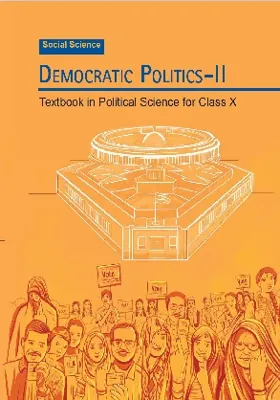
Democratic Politics II

Political Science5 Chapters

Chapter notes

What you'll learn in Democratic Politics II

A quick revision map of Democratic Politics II — the core idea and five key takeaways from each chapter. Tap any chapter to read the full NCERT PDF and detailed notes.

01

Power Sharing

Chapter 1 of NCERT Class 10 Political Science, 'Power Sharing', explores how democracies distribute government authority among different organs, levels, and social groups to prevent tyranny and maintain stability. The chapter uses Belgium and Sri Lanka as contrasting case studies—one showing successful power-sharing arrangements, the other demonstrating the dangers of majoritarianism.

  • 1Belgium's constitutional amendments created a federal system with equal Dutch-French representation, state governments, and community governments for cultural/educational matters.
  • 2Sri Lanka's majoritarian policies (1956 Sinhala-only act, preferential hiring, Buddhism protection) alienated Tamils and led to civil war; contrasts with Belgium's accommodation model.
  • 3Prudential reasons for power sharing: reduces conflict, prevents tyranny, ensures political stability and unity.
  • 4Moral reasons: democratic rule requires those affected by governance to participate; citizens have a right to be consulted.
  • 5Four forms of power sharing: horizontal (organs of govt), vertical (central/state levels), among social groups (reserved constituencies, community governments), and among political parties (coalition governments).
02

Federalism

Chapter 2 of NCERT Class 10 Political Science, 'Federalism', explores a system of government where power is divided between a central authority and various constituent units (states). It explains how India functions as a federal country with three tiers of government and examines federalism's role in accommodating diversity while maintaining national unity.

  • 1Federalism divides power between central government and constituent state/provincial governments
  • 2India has a three-tier federal system: Union, State, and local government (panchayats and municipalities)
  • 3Three Constitutional Lists distribute powers: Union List, State List, and Concurrent List
  • 4Linguistic States created since 1947 united people of same language and strengthened the country
  • 5Language policy protects 22 Scheduled Languages and allows official exams in multiple languages
03

Gender, Religion and Caste

Chapter 3 of NCERT Class 10 Political Science, 'Gender, Religion and Caste', examines how social differences based on gender, religion, and caste express themselves in Indian politics and democracy. It explores the nature of these divisions, their political implications, and constitutional safeguards.

  • 1Sexual division of labour and gender discrimination in politics
  • 2Feminist movements and women's political representation
  • 3Communalism versus secular state model in India
  • 4Caste system as hereditary occupational division with ritual sanctions
  • 5Caste politics through candidate selection and electoral coalitions
04

Political Parties

Chapter 4 of NCERT Class 10 Political Science, "Political Parties", explores what political parties are, their essential functions in democracy, different party systems (one-party, two-party, and multi-party), and the challenges they face including lack of internal democracy, dynastic succession, money and muscle power, and reduced ideological differences.

  • 1Political parties contest elections, hold government power, make laws, and shape public policy
  • 2Three party systems: one-party (undemocratic), two-party (US, UK model), and multi-party (India's system)
  • 3National parties must secure 6% votes in national elections or 4 seats in Lok Sabha; state parties need 6% votes and 2 seats in state assembly
  • 4Major challenges: lack of internal democracy, dynastic succession limiting ordinary members' rise to leadership
  • 5Growing influence of money and muscle power in elections, with wealthy donors gaining policy influence
05

Outcomes of Democracy

Chapter 5 of NCERT Class 10 Political Science, "Outcomes of Democracy", examines what we can reasonably expect from democracy—such as accountable government, economic growth, reduced inequality, accommodation of social diversity, and protection of dignity and freedom—and evaluates whether democracies actually deliver these outcomes in practice.

  • 1Accountable and responsive government through elections, transparency, and citizen participation
  • 2Economic growth varies between democracies and dictatorships; no significant difference in poor countries
  • 3Inequality persists in democracies despite economic growth; wealth concentration among the ultra-rich
  • 4Social diversity accommodation through democratic procedures that prevent violent conflict
  • 5Dignity and freedom, especially for women and disadvantaged castes, strengthened by democratic principles

More Social Science books

Want offline access with notes & solutions?

Download CBSE Prepmaster for free — includes NCERT solutions, flashcards, mock tests & more.

Download Free App