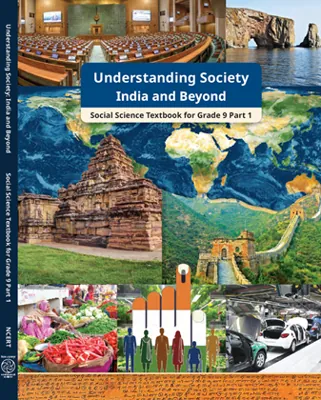
Social ScienceClass 9

Understanding Society: India and Beyond (Part 1)

2026-27 Edition9 Chapters

Chapter notes

What you'll learn in Understanding Society: India and Beyond (Part 1)

A quick revision map of Understanding Society: India and Beyond (Part 1) — the core idea and five key takeaways from each chapter. Tap any chapter to read the full NCERT PDF and detailed notes.

01

Understanding Social Science

Chapter 1 of the Class 9 Social Science NCERT textbook, "Understanding Social Science", introduces Social Science as the systematic study of human society and explains why it is divided into four core disciplines — Geography, History, Political Science, and Economics. It connects India's ancient knowledge traditions to modern social inquiry and shows how everyday life is shaped by environment, governance, economy, and culture.

  • 1Social Science is the systematic study of human society, explaining why events happen, how people live together, and how environments, governments, and economies shape life.
  • 2In Grades 9–10, Social Science draws from four core disciplines: Geography, History, Political Science, and Economics.
  • 3India's ancient texts such as the Arthaśhāstra (attributed to Kauṭilya, ~2,300 years ago) reflect systematic early thinking about governance, administration, and economics.
  • 4The concept of Pañchamahābhūtas (five great elements — earth, water, fire, air, space) from Indian philosophical traditions represents an early understanding of nature as an interconnected system.
  • 5History uses diverse sources: archaeological (artefacts, monuments), literary (travelogues, manuscripts), epigraphic (stone and metal inscriptions), and numismatic (coins) sources.
02

Shaping of the Earth's Surface

Chapter 2 of the Class 9 Social Science NCERT textbook, "Shaping of the Earth's Surface", explains how internal forces like plate tectonics, earthquakes, and volcanic eruptions, and external forces like weathering, erosion, and deposition by running water, glaciers, wind, and underground water, together create the diverse landforms on Earth. It also covers how these landforms influence human settlements, livelihoods, and how disasters such as landslides, avalanches, GLOFs, and dust storms are associated with specific landforms.

  • 1Plate tectonics, proposed by W.J. Morgan, explains Earth's crust is divided into tectonic plates including the Pacific, Eurasian, African, Indo-Australian, and Antarctic plates that move a few centimetres per year.
  • 2Convergent boundaries form fold mountains like the Himalayas when continental plates collide; divergent boundaries create mid-ocean ridges like the Mid-Atlantic Ridge; transform boundaries cause earthquakes like along the San Andreas Fault.
  • 3Most earthquakes and volcanoes occur along plate boundaries, especially around the Pacific Ocean in the area known as the Ring of Fire.
  • 4Weathering has three types: physical (temperature, frost, wind), chemical (reactions with water, air, or acids), and biological (plant roots, micro-organisms splitting rocks).
  • 5Running water creates V-shaped valleys and waterfalls in the upper course, meanders and oxbow lakes in the middle course, and deltas and alluvial fans in the lower course.
03

Atmosphere and Climate

Chapter 3 of the Class 9 Social Science NCERT textbook, "Atmosphere and Climate", explains the composition and layered structure of Earth's atmosphere, the key elements of weather and climate, India's four IMD-recognised seasons, the mechanism of the southwest and northeast monsoon, and the causes and effects of climate change. It also uses the 2025 Punjab floods as a case study to connect monsoon behaviour with real-world disaster impact.

  • 1The atmosphere is held around Earth by gravity and is composed mainly of nitrogen (78%) and oxygen (21%), with small amounts of carbon dioxide (0.04%), argon (0.93%), water vapour (0.1–0.4%), and dust particles.
  • 2The five atmospheric layers from surface to space are: troposphere (weather occurs here, average 12 km), stratosphere (contains the ozone layer, up to 50 km), mesosphere (meteorites burn up here, up to 80 km), thermosphere (auroras and radio-wave reflection, 80–700 km), and exosphere (outermost, very thin air).
  • 3Temperature decreases with altitude only in the troposphere and mesosphere; it rises in the thermosphere as gas molecules absorb solar X-rays and ultraviolet radiation.
  • 4Insolation (incoming solar energy) decreases from equator to poles, so temperature also decreases from equator to poles.
  • 5Air always moves from high-pressure to low-pressure areas, forming wind; high-temperature zones create low pressure (cloudy/wet), and low-temperature zones create high pressure (clear/sunny).
04

Early Humans and Beginning of Civilisation

Chapter 4 of the Class 9 Social Science NCERT textbook, "Early Humans and Beginning of Civilisation", traces human evolution from australopithecines in Africa through the Stone Age periods to the rise of Bronze Age river-valley civilisations including the Sindhu-Sarasvatī, Mesopotamian, Egyptian, and Chinese civilisations. It explains how archaeology, fossils, and early writing systems help reconstruct prehistoric human life before written records existed.

  • 1Homo erectus, inventor of handaxes and cleavers, was the first hominin to migrate out of Africa around 2 million years ago; Homo sapiens followed in a second major wave around 125,000 years ago.
  • 2More than 99% of human history falls before the invention of writing and is reconstructed primarily through archaeological evidence such as tools, fossils, and cave art.
  • 3The Stone Age is divided into Palaeolithic (hunting-gathering, stone tools), Mesolithic (microlithic tools, warmer climate, population growth), and Neolithic (agriculture, domestication, pottery, permanent villages).
  • 4The Neolithic Revolution was not simultaneous worldwide—Mehrgarh in present-day Pakistan is the oldest Neolithic site in the Indian subcontinent, dating to about 7000 BCE, while farming spread to the Ganga plains later.
  • 5The Sumerians of Mesopotamia were the first to develop a city-based civilisation and invented cuneiform writing around 3200 BCE, the wheeled cart, sailboat, and a number system based on 60.
05

State and Society up to 1000 CE

Chapter 5 of the Class 9 Social Science NCERT textbook, "State and Society up to 1000 CE", traces how Indian political organisation evolved from kin-based Vedic clans through janapadas and mahājanapadas to large empires like the Mauryas, Guptas, and Cholas, while examining the social structures, economic systems, and ethical ideals that shaped early Indian civilisation. It also explores the roles of dharma, the chakravarti ideal, varṇa and jāti, trade networks, guilds, education, and the Bhakti tradition up to the end of the first millennium CE.

  • 1Early Vedic society was organised into clans (janas); the Ṛigveda mentions about thirty janas, five of which were collectively called the pañchajana.
  • 2The transition from kin-based janas to territory-based janapadas occurred between approximately 1000 BCE and 600 BCE; sixteen mahājanapadas emerged by around 600 BCE, with Magadha becoming the most powerful.
  • 3Kauṭilya's Arthaśhāstra identified the seven constituents of the state (Saptāṁga) as the king, ministers, territory, forts, treasury, army, and allies, and stressed that governance required collective, multi-layered administration.
  • 4The concept of dharma—meaning duty, righteousness, and moral conduct—guided both rulers and subjects; Aśhoka's edicts promoted dhamma emphasising non-violence, compassion, and ethical behaviour.
  • 5The varṇa system was originally functional and flexible; early texts show occupational diversity within families, and rulers of different varṇa backgrounds (Nandas, Mauryas, Guptas, etc.) ruled major empires.
06

Democracy

Chapter 6 of the Class 9 Social Science NCERT textbook, "Democracy", traces the historical roots of democratic thought in India from Vedic-era assemblies through the Constituent Assembly, explains the core principles of democracy such as popular sovereignty, rule of law, fundamental rights, and separation of powers, and examines the different types of democracy practised in India and globally. It also discusses challenges to Indian democracy including the 1975-77 Emergency, the spread of misinformation, and the role citizens can play in strengthening democratic institutions.

  • 1India is the world's largest democracy with over 96.8 crore registered voters in 2024 and a population exceeding 140 crore.
  • 2Democratic traditions in India have ancient roots: Vedic assemblies (Sabha, Samiti, Vidhata) and Buddhist Sanghas practised collective decision-making and voting.
  • 3The Constituent Assembly took 2 years, 11 months, and 18 days to draft the Indian Constitution, which came into force on 26 January 1950.
  • 4Universal Adult Franchise gives every citizen aged 18 and above the right to vote through a secret ballot.
  • 5The six Fundamental Rights in the Indian Constitution range from the Right to Equality (Articles 14-18) to the Right to Constitutional Remedies (Article 32).
07

Elections

Chapter 7 of the Class 9 Social Science NCERT textbook, "Elections", explains why periodic elections are essential to democracy and how India's electoral machinery — from the Election Commission of India to the Representation of the People Acts — ensures free, fair, and transparent voting. It also covers electoral systems such as First-Past-The-Post and proportional representation, the role of political parties, delimitation of constituencies, and the challenges elections face in practice.

  • 1Elections to the Lok Sabha, Vidhan Sabha, and local bodies are held through direct elections every five years; the President, Vice President, and Rajya Sabha members are elected through indirect elections.
  • 2India uses the First-Past-The-Post (FPTP) electoral system for Lok Sabha and Vidhan Sabha elections, while the Rajya Sabha and Presidential elections use proportional representation by single transferable vote.
  • 3The Election Commission of India (ECI), established on 25 January 1950, is an autonomous constitutional body empowered under Articles 324–329 to conduct and supervise all elections.
  • 4The Representation of the People Act, 1950 deals with delimitation of constituencies and electoral rolls, while the RPA, 1951 covers nomination, campaigns, voting procedures, offences, and post-election disputes.
  • 5Delimitation is the process of periodically redrawing constituency boundaries to ensure equal representation; India has had four Delimitation Commissions — in 1952, 1963, 1973, and 2002.
08

Building Blocks in Economics: The Problem of Choice

Chapter 8 of the Class 9 Social Science NCERT textbook, "Building Blocks in Economics: The Problem of Choice", introduces the core problem of economics — unlimited human wants versus limited resources — and explains how individuals, enterprises, and governments make choices using concepts like opportunity cost, the Production Possibility Curve, and the three key economic questions of what, how, and for whom to produce. It also compares planned, market, and mixed economic systems and traces how India shifted from a state-led to a more market-oriented economy after 1991.

  • 1Human wants are unlimited and keep changing, while resources (natural and human-made) are limited — this mismatch is called scarcity and forces economic choices.
  • 2Opportunity cost is the value of the best alternative given up when a choice is made; for example, a farmer choosing barley over wheat gives up the gains from wheat production.
  • 3The Production Possibility Curve (PPC) shows all efficient combinations of two goods producible with given resources; all points on it represent maximum output with no waste.
  • 4Economics deals with three key questions — what to produce, how to produce, and for whom to produce — which every economy must resolve given scarce resources.
  • 5Production methods can be labour-intensive (agriculture, handicrafts) or capital-intensive (steel, automobile manufacturing) depending on cost of inputs, technology, and government regulations.
09

The Price Puzzle: What Drives the Market

Chapter 9 of the Class 9 Social Science NCERT textbook, "The Price Puzzle: What Drives the Market", explains how demand and supply interact to determine prices of goods and services, what causes prices to change in the real world, and how the government intervenes when markets produce unfair or inefficient outcomes. It covers the Law of Demand, the Law of Supply, market equilibrium, and the role of regulators like RBI, SEBI, and TRAI in India's market economy.

  • 1Demand is the willingness AND ability (purchasing power) to buy a good at a particular price — desire alone does not constitute demand.
  • 2The Law of Demand shows an inverse relationship: when price rises, quantity demanded falls; when price falls, quantity demanded rises.
  • 3Market demand is the sum of all individual demands; the market demand curve is flatter than an individual demand curve because the same price change creates a larger total quantity response.
  • 4The Law of Supply shows a direct relationship: higher prices increase profitability, incentivising producers to supply more.
  • 5Market equilibrium is where quantity demanded equals quantity supplied (no shortage, no surplus); in the chapter's mango example this is Rs 100/kg and 12 kg.

Want offline access with notes & solutions?

Download CBSE Prepmaster for free — includes NCERT solutions, flashcards, mock tests & more.

Download Free App