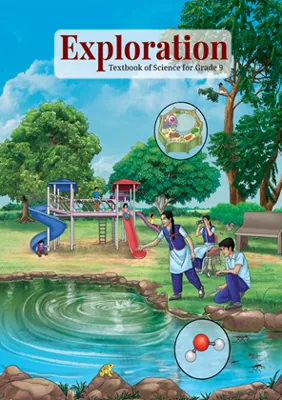
ScienceClass 9

Exploration

2026-27 Edition13 Chapters

Chapter notes

What you'll learn in Exploration

A quick revision map of Exploration — the core idea and five key takeaways from each chapter. Tap any chapter to read the full NCERT PDF and detailed notes.

01

Exploring: Entering the World of Secondary Science

Class 9 Science Chapter 1 of the NCERT 2026-27 'Exploration' textbook introduces students to the secondary stage of science, emphasising deep exploration through models, precise language, mathematics, laws, theories, and estimation rather than just memorising facts.

  • 1Science at the secondary stage focuses on deep exploration: understanding how observations lead to measurements, how models are built, and how ideas are tested, revised, or discarded.
  • 2Scientific models are simplified representations of reality that deliberately ignore certain details to answer specific questions — for example, ignoring air resistance when studying a falling object.
  • 3Science uses a shared, precise language of terms, symbols, and SI units so that scientists worldwide can compare results and build ideas together.
  • 4A scientific law describes a regular pattern in nature; a theory explains why that pattern occurs based on evidence; and a principle is a broad guiding idea applicable in a given situation.
  • 5Prediction is a core scientific tool — when predictions match observations, confidence in the science grows; when they do not, scientists re-examine their assumptions and models.
02

Cell: The Building Block of Life

The cell is the basic structural and functional unit of all living organisms. All living organisms are composed of cells, and all cells arise from pre-existing cells.

  • 1The cell is the basic structural and functional unit of all living organisms; unicellular organisms like bacteria consist of a single cell, while multicellular organisms like humans have millions of cells working together.
  • 2Prokaryotic cells (e.g., bacteria) lack a well-defined nucleus and membrane-bound organelles; eukaryotic cells (plants and animals) have a true nucleus and membrane-bound organelles.
  • 3The cell membrane is selectively permeable and follows the fluid-mosaic model — a lipid bilayer with embedded proteins that act as gatekeepers for substance transport.
  • 4Plant cells have a rigid cell wall made primarily of cellulose outside the cell membrane, which provides structural support; animal cells lack a cell wall and can change shape more freely.
  • 5Mitochondria are the powerhouses of the cell, producing ATP through cellular respiration; chloroplasts in plant cells carry out photosynthesis using chlorophyll to absorb sunlight.
03

Tissues in Action

Chapter 3 of Class 9 Science (NCERT 2026-27 'Exploration' edition) covers tissues in plants and animals — how groups of similar cells work together to perform specific functions, enabling division of labour and complex life processes.

  • 1Plant meristematic tissues (apical, lateral, intercalary) drive growth in length, girth, and regeneration after cutting respectively; their cells have thin walls, dense cytoplasm, large nucleus, and no vacuoles.
  • 2Permanent plant tissues are either simple (parenchyma — food storage/photosynthesis; collenchyma — flexibility; sclerenchyma — strength via lignin) or complex (xylem — water/mineral transport; phloem — food transport via sieve tubes).
  • 3The epidermis, covered by a waxy cuticle, forms the outermost protective layer of plants; stomata in leaves enable gaseous exchange and transpiration.
  • 4Animal tissues are of four main types: epithelial (body covering and lining), connective (blood, bone, cartilage, tendons, ligaments), muscular (skeletal, smooth, cardiac), and nervous (neurons that receive and transmit impulses).
  • 5Skeletal muscles are voluntary (striated, multinucleate, cylindrical fibres); smooth muscles are involuntary (spindle-shaped, single nucleus, non-striated); cardiac muscles are involuntary, branched, and work without fatigue.
04

Describing Motion Around Us

Chapter 4 of the NCERT Class 9 Science textbook (2026-27 'Exploration' edition) covers describing motion, introducing displacement, average speed, average velocity, average acceleration, kinematic equations, and uniform circular motion. It explains how to analyse linear motion using position-time and velocity-time graphs.

  • 1Displacement is the net change in position between two instants, requiring both magnitude and direction; it can be zero even when total distance travelled is non-zero (e.g., an athlete who runs and returns to the start)
  • 2Average speed equals total distance divided by time interval; average velocity equals displacement divided by time interval (v_av = s/t), with SI unit m s⁻¹
  • 3Average acceleration equals change in velocity divided by time interval (a = (v − u)/t), with SI unit m s⁻²; acceleration can exist even when speed is constant, if direction changes
  • 4The three kinematic equations for straight-line motion with constant acceleration are: v = u + at, s = ut + ½at², and v² = u² + 2as
  • 5On a position-time graph, the slope of the line gives the magnitude of velocity; a straight line indicates constant velocity and a curve indicates changing (accelerated) velocity
05

Exploring Mixtures and their Separation

Chapter 5 of Class 9 Science (NCERT 2026-27 'Exploration' edition) covers mixtures and their separation, classifying mixtures as solutions, suspensions, or colloids and teaching techniques like crystallization, distillation, paper chromatography, sublimation, centrifugation, and coagulation.

  • 1Mixtures are classified as homogeneous (solutions) or heterogeneous (suspensions, colloids); particle size distinguishes them: solutions < 1 nm, colloids 1–1000 nm, suspensions > 1000 nm.
  • 2Concentration of a solution is expressed as mass by mass (% m/m), mass by volume (% m/v), or volume by volume (% v/v) percentage.
  • 3Solubility of solid solutes generally increases with temperature, while solubility of gases in liquids decreases with temperature.
  • 4Crystallization separates or purifies solids from saturated solutions; distillation separates miscible liquids with boiling points differing by at least 25 °C.
  • 5Sublimation separates substances that convert directly from solid to vapour (e.g., camphor) without passing through the liquid state; immiscible liquids are separated using a separating funnel.
06

How Forces Affect Motion

Chapter 6 of NCERT Class 9 Science (Exploration, 2026-27 edition) explains how forces affect motion by covering Newton's three laws of motion, the concept of balanced and unbalanced forces, and the force of friction, with the SI unit of force being the newton (N).

  • 1Force is a vector quantity with both magnitude and direction; the SI unit is the newton (N), defined as the force producing 1 m/s² acceleration on a 1 kg mass.
  • 2Balanced forces are equal in magnitude and opposite in direction and produce no change in motion; unbalanced forces result in a net force that causes acceleration.
  • 3The force of friction acts opposite to the direction of motion and depends on the nature of surfaces in contact; smoother surfaces produce less friction and allow objects to travel farther.
  • 4Newton's First Law: an object at rest stays at rest and a moving object continues at constant velocity unless a net force acts on it.
  • 5Newton's Second Law: F = ma — net force equals mass times acceleration; acceleration increases with greater force and decreases with greater mass.
07

Work, Energy and Simple Machines

Chapter 7 of the NCERT Class 9 Science textbook 'Exploration' (2026-27 edition) covers work, energy, power, and simple machines. It defines work as force multiplied by displacement in the direction of force (W = F × s), explains kinetic energy (K = ½mv²) and gravitational potential energy (U = mgh), the work-energy theorem, conservation of mechanical energy, power (P = W/t), and three simple machines: pulley, inclined plane, and lever.

  • 1Work is done on an object only when a force causes displacement in the direction of the force; W = F × s (SI unit: joule, J).
  • 2The work-energy theorem states that the work done on an object equals the change in its energy; kinetic energy K = ½mv² and gravitational potential energy U = mgh.
  • 3Mechanical energy (sum of kinetic and potential energy) is conserved when no external forces other than gravity act on an object, as demonstrated by a freely falling body and a simple pendulum.
  • 4Power is the rate at which work is done: P = W/t; the SI unit is watt (W), where 1 W = 1 J s⁻¹.
  • 5Simple machines (pulley, inclined plane, lever) reduce the effort needed by changing the magnitude or direction of force, but do not reduce the total work done; mechanical advantage = load ÷ effort.
08

Journey Inside the Atom

Chapter 8 'Journey Inside the Atom' from NCERT Class 9 Science (Exploration, 2026-27 edition) traces the evolution of atomic theory from ancient thinkers like Acharya Kanada and Democritus through Dalton, Thomson, Rutherford, and Bohr, explaining subatomic particles (electrons, protons, neutrons), atomic number, mass number, electronic configuration, valency, isotopes, and isobars.

  • 1J. J. Thomson discovered electrons in 1897 using cathode ray tube experiments and proposed the plum pudding (watermelon) model of the atom.
  • 2Rutherford's gold foil experiment (1911) showed that most of an atom is empty space with a tiny, dense, positively charged nucleus at the centre; the atom's diameter is ~10⁻¹⁰ m and the nucleus ~10⁻¹⁵ m.
  • 3Bohr's model (1913) proposed that electrons revolve in fixed energy shells (K, L, M, N) without losing energy; the maximum electrons per shell follow the formula 2n².
  • 4James Chadwick discovered the neutron in 1932, explaining why atomic masses are greater than the sum of protons alone; neutrons are found in all nuclei except hydrogen.
  • 5Atomic number (Z) equals the number of protons; mass number (A) equals protons plus neutrons; valency is the number of electrons gained, lost, or shared to complete the outermost shell octet.
09

Atomic Foundations of Matter

Class 9 Science Chapter 9 'Atomic Foundations of Matter' covers the Law of Conservation of Mass, the Law of Constant Proportions, Dalton's Atomic Theory, covalent and ionic bonding, chemical formulae, and molecular and formula unit mass calculations.

  • 1Law of Conservation of Mass: total mass of reactants equals total mass of products in any chemical reaction, proposed by Antoine Lavoisier in 1789.
  • 2Law of Constant Proportions (Proust's Law): elements in a compound always combine in a fixed ratio by mass regardless of source — water always contains hydrogen and oxygen in the ratio 1:8.
  • 3Dalton's Atomic Theory postulates that atoms are indivisible, identical within an element, differ between elements, and combine in simple whole-number ratios to form compounds.
  • 4Covalent bonds form by sharing of electrons between atoms (single bond: one shared pair; double bond: two shared pairs); examples include H2, Cl2, O2, HCl, and H2O.
  • 5Ionic bonds form by transfer of electrons, producing cations (e.g., Na+) and anions (e.g., Cl-) held together by electrostatic attraction; ionic compounds generally have high melting points and conduct electricity only when dissolved in water.
10

Sound Waves: Characteristics and Applications

Sound Waves: Characteristics and Applications (Class 9 Science, Chapter 10) covers how sound is produced by vibrating objects, travels as a longitudinal mechanical wave through compressions and rarefactions, and finds applications ranging from echo and sonar to ultrasonic medical imaging.

  • 1Sound is produced by vibrating objects and propagates as alternating compressions and rarefactions in a medium; it cannot travel through vacuum.
  • 2Sound is a longitudinal mechanical wave — particles of the medium oscillate parallel to the direction of wave propagation, but do not travel with the wave.
  • 3Key wave quantities: wavelength (λ, SI unit m), frequency (ν, SI unit Hz), time period T, with the relations ν = 1/T and wave speed v = λ × ν.
  • 4Speed of sound depends on the medium: approximately 340 m s⁻¹ in air at room temperature, ~1500 m s⁻¹ in water, and ~5000 m s⁻¹ in steel; it increases with temperature.
  • 5The minimum distance from a reflecting surface to hear an echo is 17 m (based on the 0.1 s minimum separation time at 340 m s⁻¹ speed of sound).
11

Reproduction — How Life Continues

Chapter 11 of NCERT Class 9 Science (2026-27 'Exploration' edition) covers reproduction — the biological process by which living organisms produce new individuals — exploring asexual reproduction (vegetative propagation, budding, spore formation) and sexual reproduction in plants, animals, and humans.

  • 1Asexual reproduction involves one parent and produces genetically identical clones via mitosis; methods include vegetative propagation (cutting, grafting, layering, tissue culture), budding in hydra, and spore formation in fungi.
  • 2Sexual reproduction involves two parents; meiosis halves the chromosome number to form gametes (sperm and eggs), and the random mixing of chromosomes during meiosis creates genetic variation among offspring.
  • 3In flowering plants, the stamen (male) produces pollen grains and the pistil (female) contains the ovary with ovules; pollination transfers pollen from anther to stigma via wind, water, insects, or birds, after which fertilisation forms a zygote that develops into a seed inside the fruit.
  • 4In animals, external fertilisation occurs outside the body (fish, frogs) producing many eggs with low survival rates, while internal fertilisation occurs inside the female (reptiles, birds, mammals) with fewer eggs and higher survival rates.
  • 5In humans, one mature egg is released monthly from the ovaries (ovulation); if fertilised by sperm in the oviduct, a zygote forms, implants in the uterus, and pregnancy of about nine months begins divided into three trimesters; if unfertilised, the uterine lining sheds as menstruation.
12

Patterns in Life: Diversity and Classification

Chapter 12 of Class 9 Science (NCERT 2026-27 'Exploration' edition) explains biodiversity and biological classification — how and why scientists group the enormous variety of life on Earth into an organised system of five kingdoms based on cell type, cell structure, level of organisation, and mode of nutrition.

  • 1Biodiversity is the immense variety of living organisms on Earth; India is a global biodiversity hotspot with regions like the Western Ghats, Himalayas, and Indo-Burma harbouring many endemic species.
  • 2Whittaker's five kingdom classification (1969) groups all life into Monera, Protista, Fungi, Plantae and Animalia based on cell type (prokaryote/eukaryote), level of organisation (unicellular/multicellular), and mode of nutrition (autotrophic/heterotrophic).
  • 3Kingdom Plantae is divided into five classes — Thallophyta, Bryophyta, Pteridophyta, Gymnosperm and Angiosperm — showing a progression from water-dependent simple plants to seed-bearing flowering plants adapted for life on land.
  • 4Kingdom Animalia is classified first by the presence or absence of a notochord (invertebrates vs chordates); invertebrates span eight phyla from simple Porifera to complex Echinodermata, while vertebrates include fish, amphibians, reptiles, birds and mammals.
  • 5Binomial nomenclature, introduced by Carolus Linnaeus in the 18th century, gives every organism a universal two-part Latin scientific name (genus + species), eliminating confusion caused by different regional common names.
13

Earth as a System: Energy, Matter, and Life

Chapter 13 of NCERT Class 9 Science (2026-27 'Exploration' edition) explains Earth as an interconnected system of five spheres — geosphere, hydrosphere, cryosphere, atmosphere, and biosphere — through which energy from the Sun and matter continuously flow and cycle to sustain life.

  • 1Earth is divided into five interacting spheres: geosphere, hydrosphere, cryosphere, atmosphere, and biosphere; a disturbance in one affects all others.
  • 2The Sun's electromagnetic radiation (concentrated in UV, visible, and infrared bands) is the primary energy source; the solar constant at the top of the atmosphere is approximately 1.4 kWm⁻².
  • 3Uneven heating of Earth's surface due to latitude and spherical shape drives planetary winds, local breezes (valley and mountain), and ocean currents such as gyres and the Gulf Stream.
  • 4Biogeochemical cycles — water, carbon, nitrogen, and oxygen — recycle essential nutrients between abiotic and biotic components, sustaining life and regulating climate.
  • 5Human activities have raised atmospheric CO₂ by about 35% since 1960 (from 315 ppm to 420 ppm), intensifying the greenhouse effect and disrupting water, carbon, and nitrogen cycles.

More Science books

Want offline access with notes & solutions?

Download CBSE Prepmaster for free — includes NCERT solutions, flashcards, mock tests & more.

Download Free App