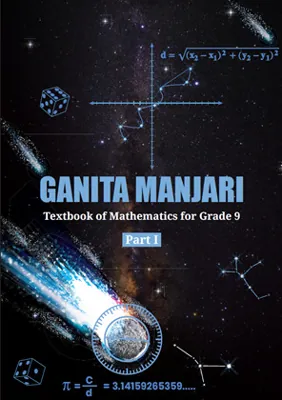
MathematicsClass 9

Ganita Manjari

2026-27 Edition8 Chapters

Chapter notes

What you'll learn in Ganita Manjari

A quick revision map of Ganita Manjari — the core idea and five key takeaways from each chapter. Tap any chapter to read the full NCERT PDF and detailed notes.

01

Orienting Yourself: The Use of Coordinates

Chapter 1 of NCERT Class 9 Maths, "Orienting Yourself: The Use of Coordinates", introduces the 2-D Cartesian coordinate system, showing how any point in a plane is located using an ordered pair (x, y) measured from two perpendicular axes, and how to find the distance between two points.

  • 1The 2-D system uses two perpendicular lines: horizontal x-axis and vertical y-axis
  • 2The origin O is where the axes meet; its coordinates are (0, 0)
  • 3Axes divide the plane into four quadrants with sign patterns (+,+), (-,+), (-,-), (+,-)
  • 4x-coordinate is distance from the y-axis; y-coordinate is distance from the x-axis
  • 5Points on the x-axis are (x, 0); points on the y-axis are (0, y)
02

Introduction to Linear Polynomials

Chapter 2 of NCERT Class 9 Maths, "Introduction to Linear Polynomials", introduces univariate polynomials and their degree, then focuses on linear polynomials (degree 1), linear patterns, linear growth and decay, linear relationships of the form y = ax + b, and plotting them as straight lines.

  • 1The degree of a polynomial is the highest power of its variable
  • 2Polynomials by degree: constant 0, linear 1, quadratic 2, cubic 3
  • 3A linear polynomial has degree 1, such as 3z + 7 or 2x + 3
  • 4Evaluate a polynomial by substituting a value of the variable
  • 5A linear pattern has a constant difference between consecutive terms
03

The World of Numbers

Chapter 3 of NCERT Class 9 Maths, "The World of Numbers", traces how number systems grew from natural numbers and zero to integers, rational numbers, irrational numbers and real numbers, covering Brahmagupta's rules, decimal expansions and the proof that sqrt(2) is irrational.

  • 1Natural numbers arose from counting using one-to-one correspondence
  • 2Brahmagupta formalised zero and its arithmetic rules in 628 CE
  • 3Integers (Z) include positive numbers, zero and negative numbers (debts)
  • 4Rational numbers are p/q with integers p, q and q not equal to 0
  • 5Rational numbers are dense; one exists between any two via their average
04

Exploring Algebraic Identities

Chapter 4 of NCERT Class 9 Maths, "Exploring Algebraic Identities", introduces algebraic identities such as (a+b)^2 = a^2 + 2ab + b^2, visualises them with geometric models and algebra tiles, and uses them to expand, factorise, simplify rational expressions, and speed up calculations.

  • 1Identity (a+b)^2 = a^2 + 2ab + b^2 and (a-b)^2 = a^2 - 2ab + b^2
  • 2An identity is true for all values; an equation need not be
  • 3Three-term square: (a+b+c)^2 = a^2 + b^2 + c^2 + 2ab + 2bc + 2ca
  • 4Difference of squares: a^2 - b^2 = (a+b)(a-b)
  • 5Cube identities (a+b)^3 = a^3 + 3a^2b + 3ab^2 + b^3 and (a-b)^3
05

I'm Up and Down, and Round and Round

Chapter 5 of NCERT Class 9 Maths, "I'm Up and Down, and Round and Round", studies circles: their definition as the locus of points equidistant from a centre, their symmetries, properties of chords and the angles they subtend, arcs, and concyclic points.

  • 1A circle is the locus of points equidistant from a fixed centre
  • 2Circles have full rotational symmetry and reflection symmetry across any diameter
  • 3Infinitely many circles pass through two points; centres lie on the perpendicular bisector
  • 4A unique circumcircle passes through three non-collinear points
  • 5Equal chords subtend equal angles at the centre, and conversely
06

Measuring Space: Perimeter and Area

Chapter 6 of NCERT Class 9 Maths, "Measuring Space: Perimeter and Area", teaches how to measure the perimeter and area of shapes, covering the circle's circumference (2*pi*r), arc length, sectors, the area of triangles, Heron's formula, and the area of a circle (pi*r^2).

  • 1Perimeter of a circle (circumference) is C = 2*pi*r, with diameter d giving pi*d
  • 2pi is the irrational circumference-to-diameter (C/D) ratio, about 22/7 or 3.14
  • 3Arc length subtending angle t degrees is 2*pi*r * (t/360)
  • 4Area of a triangle equals half base times height (1/2 * b * h)
  • 5Heron's formula: area = sqrt(s(s-a)(s-b)(s-c)), where s = (a+b+c)/2
07

The Mathematics of Maybe: Introduction to Probability

Chapter 7 of NCERT Class 9 Maths, "The Mathematics of Maybe: Introduction to Probability", introduces probability as a measure of how likely a random event is, scaled from 0 (impossible) to 1 (certain), covering experimental and theoretical probability, sample spaces, events, and tree diagrams.

  • 1Probability measures likelihood on a scale from 0 (impossible) to 1 (certain)
  • 2Randomness means outcomes are known but each result is unpredictable
  • 3Experimental probability = times event occurred / total number of trials
  • 4Theoretical probability P = favourable outcomes / possible outcomes
  • 5Sample space S lists all possible outcomes; n(S) is the sample size
08

Predicting What Comes Next: Exploring Sequences and Progressions

Chapter 8 of NCERT Class 9 Maths, "Predicting What Comes Next: Exploring Sequences and Progressions", introduces sequences as ordered lists of numbers and teaches explicit and recursive rules, arithmetic progressions, geometric progressions, and the sum of the first n natural numbers.

  • 1A sequence is an ordered list of numbers; each number is a term
  • 2An explicit rule uses position n to compute the nth term directly
  • 3A recursive rule defines each term from previous terms
  • 4Virahanka-Fibonacci: V1 = 1, V2 = 2, Vn = V(n-1) + V(n-2)
  • 5AP nth term: tn = a + (n - 1)d, with common difference d

More Mathematics books

Want offline access with notes & solutions?

Download CBSE Prepmaster for free — includes NCERT solutions, flashcards, mock tests & more.

Download Free App