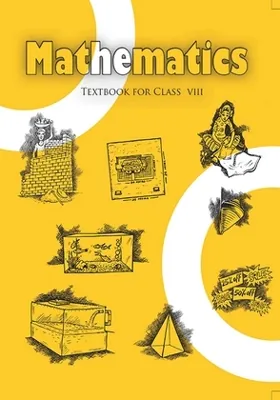
MathematicsClass 8

Mathematics

2025-26 Edition13 Chapters

Chapter notes

What you'll learn in Mathematics

A quick revision map of Mathematics — the core idea and five key takeaways from each chapter. Tap any chapter to read the full NCERT PDF and detailed notes.

01

Rational Numbers

Chapter 1 of Class 8 maths, "Rational Numbers", teaches what rational numbers are (numbers written as p/q where p and q are integers and q ≠ 0), and explores their key properties including closure, commutativity, associativity, and distributivity across addition, subtraction, multiplication, and division operations.

  • 1A rational number is any number that can be written as p/q where p and q are integers and q ≠ 0. Examples: 2/3, −6/7, 9/−5, and even 0, −2, and 4 (written as 0/1, −2/1, 4/1).
  • 2Rational numbers are closed under addition, subtraction, and multiplication (the sum, difference, and product of any two rational numbers is always a rational number), but NOT closed under division (division by zero is undefined).
  • 3Addition and multiplication of rational numbers are both commutative (a + b = b + a and a × b = b × a), but subtraction and division are NOT commutative.
  • 4Addition and multiplication of rational numbers are both associative (a + (b + c) = (a + b) + c and a × (b × c) = (a × b) × c), but subtraction and division are NOT associative.
  • 5Zero is the additive identity (a + 0 = a for any rational number a) and 1 is the multiplicative identity (a × 1 = a for any rational number a).
02

Linear Equations in One Variable

Chapter 2 of Class 8 Maths, 'Linear Equations in One Variable', teaches students how to solve algebraic equations that contain only one variable with a highest power of 1. Students learn to balance equations using transposition and various algebraic methods to find solutions.

  • 1A linear equation in one variable has only one variable with highest power equal to 1 (e.g., 2x, 3y – 7)
  • 2The solution of an equation is the value of the variable for which LHS equals RHS (e.g., x = 5 is a solution of 2x – 3 = 7)
  • 3Equations can have variables on both sides; solve by moving variable terms to one side using transposition
  • 4To clear fractions, multiply both sides of the equation by the LCM (Least Common Multiple) of all denominators
  • 5Simplify equations by opening brackets and combining like terms before applying transposition methods
03

Understanding Quadrilaterals

Chapter 3 of Class 8 mathematics, "Understanding Quadrilaterals", teaches the properties, classification, and geometric relationships of quadrilaterals (four-sided polygons), including trapeziums, parallelograms, kites, rhombuses, rectangles, and squares, along with their angles and diagonals.

  • 1The sum of exterior angles of any polygon is 360°
  • 2A parallelogram has opposite sides equal, opposite angles equal, adjacent angles supplementary, and diagonals that bisect each other
  • 3A kite has two pairs of consecutive equal sides, perpendicular diagonals, and one diagonal bisects the other
  • 4A rhombus (all sides equal) has perpendicular diagonals that bisect each other
  • 5A rectangle (parallelogram with right angles) has equal diagonals that bisect each other
04

Data Handling

Chapter 4 of Class 8 Mathematics, "Data Handling", teaches how to organize, represent, and interpret data using pictographs, bar graphs, double bar graphs, and pie charts (circle graphs). It also introduces probability, covering random experiments, equally likely outcomes, and how to calculate the probability of events.

  • 1A pictograph uses symbols to represent data, where one symbol stands for a fixed quantity (e.g., one symbol = 100 cars)
  • 2A bar graph displays data using bars of uniform width with heights proportional to values; used for comparing different categories
  • 3A double bar graph shows two sets of data simultaneously for easy comparison between related categories
  • 4A pie chart (circle graph) divides a circle into sectors, where sector size is proportional to the data it represents
  • 5To draw a pie chart, calculate the central angle for each sector using: Central angle = (Value/Total) × 360°
05

Squares and Square Roots

Chapter 5 of Class 8 mathematics, 'Squares and Square Roots', teaches students to identify and calculate perfect square numbers (numbers that are products of a number multiplied by itself), understand their properties, and find square roots using methods like prime factorization and long division.

  • 1Square numbers (perfect squares) are formed when a natural number is multiplied by itself, and can only end with digits 0, 1, 4, 5, 6, or 9 in the units place
  • 2Between two consecutive perfect squares n² and (n+1)², there are exactly 2n non-perfect square numbers
  • 3Every perfect square equals the sum of the first n consecutive odd numbers, starting from 1 (e.g., 1+3+5+7+9 = 25 = 5²)
  • 4Square root is the inverse operation of squaring, found using prime factorization (pairing factors) or long division method
  • 5Pythagorean triplets are sets of three natural numbers (a, b, c) where a² + b² = c², such as (3, 4, 5), (5, 12, 13), and (6, 8, 10)
06

Cubes and Cube Roots

Chapter 6 of Class 8 maths, 'Cubes and Cube Roots', teaches students about perfect cubes (numbers obtained when a number is multiplied by itself three times), methods to identify and work with cube numbers using prime factorisation, and finding cube roots through prime factorisation and other techniques.

  • 1Perfect cubes are numbers obtained when a number is multiplied by itself three times (e.g., 2³ = 8, 3³ = 27)
  • 2In the prime factorisation of a perfect cube, every prime factor appears exactly three times
  • 3The sum of consecutive odd numbers equals perfect cubes (e.g., 1 = 1³; 3 + 5 = 2³; 7 + 9 + 11 = 3³)
  • 4The cube root of a number is the inverse operation of finding its cube (e.g., ∛8 = 2 because 2³ = 8)
  • 5Cube roots can be found by prime factorisation by grouping prime factors into triplets
07

Comparing Quantities

Chapter 7 of Class 8 maths (Mathematics Old), 'Comparing Quantities', teaches how to compare quantities using ratios and percentages, and introduces applications like finding discounts, calculating sales tax (ST/VAT/GST), and understanding compound interest on borrowed or deposited money.

  • 1Ratio compares two quantities (e.g., apples to oranges); it can be simplified using fractions or percentages
  • 2Discount = Marked Price − Sale Price; discount percent is always calculated on the marked price
  • 3Sales tax (ST), Value Added Tax (VAT), and Goods and Services Tax (GST) are added to the bill amount by the government
  • 4Compound Interest is calculated on the previous year's total amount (Principal + Interest), not just the original principal
  • 5Compound Interest formula: A = P(1 + R/100)ⁿ, where A is final amount, P is principal, R is rate per annum, and n is number of years
08

Algebraic Expressions and Identities

Chapter 8 of Class 8 Mathematics, "Algebraic Expressions and Identities," teaches how to add, subtract, and multiply algebraic expressions including monomials, binomials, trinomials, and polynomials using the distributive law and rules of exponents.

  • 1Like terms have the same variables with the same powers; add or subtract them by combining coefficients
  • 2Monomial: expression with exactly one term; multiply two monomials by multiplying coefficients and combining variable powers using exponent rules
  • 3Distributive law: multiply a monomial by a polynomial by distributing the monomial to each term in the polynomial
  • 4Binomial × binomial: each term in one binomial multiplies each term in the other; combine like terms in the result
  • 5Binomial × trinomial produces 6 terms initially (2 × 3) that may reduce when like terms are combined
09

Mensuration

Chapter 9 of Class 8 mathematics, 'Mensuration', teaches how to find the area, perimeter, surface area, and volume of plane figures and solid shapes including polygons, cubes, cuboids, and cylinders.

  • 1Polygons can be divided into triangles and trapeziums to calculate their area
  • 2Area of trapezium = (1/2) × height × (sum of parallel sides)
  • 3Area of rhombus = (1/2) × d₁ × d₂ where d₁ and d₂ are the diagonals
  • 4Surface area of cuboid = 2(lb + bh + hl) where l, b, h are length, breadth, height
  • 5Surface area of cube = 6l² where l is the side length
10

Exponents and Powers

Chapter 10 of Class 8 maths, "Exponents and Powers", teaches how to work with exponents including negative exponents, and how to express very large and very small numbers in standard form using powers of 10.

  • 1Negative exponents: for any non-zero integer a, a⁻ᵐ = 1/aᵐ, where m is a positive integer
  • 2Laws of exponents extend to negative and zero exponents: aᵐ × aⁿ = aᵐ⁺ⁿ, aᵐ ÷ aⁿ = aᵐ⁻ⁿ, (aᵐ)ⁿ = aᵐⁿ, a⁰ = 1
  • 3Standard form: expressing numbers as a × 10ⁿ where 1 ≤ a < 10 and n is an integer (positive for large numbers, negative for small numbers)
  • 4Very large numbers example: Earth-Sun distance is 1.496 × 10¹¹ m; very small numbers example: red blood cell diameter is 7 × 10⁻⁶ m
  • 5Comparing and performing arithmetic on numbers in standard form by converting to the same power of 10
11

Direct and Inverse Proportions

Chapter 11 of Class 8 Mathematics, "Direct and Inverse Proportions", teaches how two quantities can vary together (direct proportion) or in opposite directions (inverse proportion), with applications to real-world problems like costs, speeds, distances, and resource distribution.

  • 1Direct proportion occurs when two quantities x and y maintain a constant ratio (x/y = k), meaning they increase or decrease together while their ratio stays the same
  • 2In direct proportion, if x and y correspond to values x₁, y₁ and x₂, y₂, then x₁/y₁ = x₂/y₂
  • 3Inverse proportion occurs when two quantities vary such that their product remains constant (xy = k), so when one increases, the other decreases proportionally
  • 4In inverse proportion, x₁y₁ = x₂y₂, or equivalently x₁/x₂ = y₂/y₁, showing the inverse relationship
  • 5Map scales demonstrate direct proportion: a scale of 1 cm : 8 km means distances on the map and actual distances are directly proportional
12

Factorisation

Chapter 12 of Class 8 Maths, "Factorisation", teaches students how to express algebraic expressions as products of their factors. The chapter covers systematic methods for finding factors of both simple and complex algebraic expressions, including factorisation by common factors, regrouping, identities, and division of algebraic expressions.

  • 1An irreducible factor is a factor that cannot be expressed further as a product of other factors; prime factorization and algebraic factorization both identify irreducible units.
  • 2Common factor method: extract the greatest common factor from all terms, then apply the distributive law (e.g., 5xy + 10x = 5x(y + 2)).
  • 3Regrouping method: when terms lack a single common factor, group them strategically to reveal a common factor across groups (e.g., 2xy + 2y + 3x + 3 = (x + 1)(2y + 3)).
  • 4Factorisation using identities: recognize patterns matching (a + b)² = a² + 2ab + b², (a – b)² = a² – 2ab + b², or (a + b)(a – b) = a² – b², then apply the identity in reverse.
  • 5Quadratic factorisation: for x² + px + q, find two factors a and b of q such that ab = q and a + b = p, giving (x + a)(x + b).
13

Introduction to Graphs

Chapter 13 of Class 8 Mathematics, "Introduction to Graphs", teaches how to represent data visually through graphs, particularly line graphs that display data changing over time, and how to interpret and draw linear graphs to show relationships between dependent and independent variables.

  • 1Graphs are visual representations of data that make numerical facts easier to understand than tables
  • 2A line graph displays data that changes continuously over periods of time, with a horizontal axis (x-axis) and vertical axis (y-axis)
  • 3A linear graph is an unbroken line formed by joining points plotted on a coordinate grid
  • 4Independent variables affect dependent variables; for example, electricity used affects the bill amount
  • 5Linear graphs can help estimate values between plotted points by following grid lines to locate unmeasured positions

More Mathematics books

Want offline access with notes & solutions?

Download CBSE Prepmaster for free — includes NCERT solutions, flashcards, mock tests & more.

Download Free App