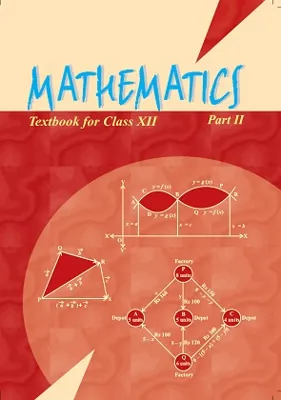
MathematicsClass 12

Mathematics Part II

NCERT Textbook8 Chapters

Chapter notes

What you'll learn in Mathematics Part II

A quick revision map of Mathematics Part II — the core idea and five key takeaways from each chapter. Tap any chapter to read the full NCERT PDF and detailed notes.

07

Integrals

NCERT Class 12 Maths Part II Chapter 7 covers Integrals — the inverse process of differentiation — including indefinite integrals, standard formulae, and methods such as substitution, partial fractions, and integration by parts, as well as definite integrals and the Fundamental Theorem of Calculus.

  • 1Integration is the inverse process of differentiation; the anti-derivative F(x) of f(x) satisfies F′(x) = f(x), and the general indefinite integral is written as F(x) + C where C is an arbitrary constant.
  • 2Standard integral formulae are derived directly from differentiation rules — for example, ∫x^n dx = x^(n+1)/(n+1) + C (n ≠ −1), ∫cos x dx = sin x + C, and ∫(1/x) dx = log|x| + C.
  • 3Integration by substitution transforms ∫f(x)dx into ∫f(g(t))g′(t)dt by letting x = g(t); key results derived this way include ∫tan x dx = log|sec x| + C and ∫sec x dx = log|sec x + tan x| + C.
  • 4Integration by partial fractions decomposes a proper rational function P(x)/Q(x) into a sum of simpler fractions whose integrals are standard, covering five canonical forms including linear, repeated linear, and irreducible quadratic factors.
  • 5Integration by parts uses the formula ∫f(x)g(x)dx = f(x)∫g(x)dx − ∫[f′(x)∫g(x)dx]dx; a special case gives ∫e^x[f(x) + f′(x)]dx = e^x f(x) + C.
08

Application of Integrals

NCERT Class 12 Maths Chapter 8, Application of Integrals, teaches how to use definite integrals to find areas bounded by curves such as circles, ellipses, parabolas, and lines — going beyond the area formulas of elementary geometry.

  • 1Area under a curve y = f(x) between x = a and x = b is given by A = ∫ₐᵇ f(x) dx using vertical strips of width dx.
  • 2Area bounded by x = g(y), the y-axis, and lines y = c and y = d is given by A = ∫꜀ᵈ g(y) dy using horizontal strips.
  • 3If a curve lies below the x-axis, the area is taken as the absolute value of the definite integral, since f(x) < 0 gives a negative result.
  • 4The area enclosed by the circle x² + y² = a² is πa², derived by integrating over one quadrant and multiplying by 4.
  • 5The area enclosed by the ellipse x²/a² + y²/b² = 1 is πab, obtained similarly using the symmetry of the ellipse.
09

Differential Equations

NCERT Class 12 Mathematics Chapter 9 covers Differential Equations, teaching students how to form and solve first-order differential equations using three methods: variables separable, homogeneous, and linear differential equations.

  • 1Order of a differential equation is defined as the order of the highest order derivative of the dependent variable present in the equation; order and degree are always positive integers when defined.
  • 2Degree is the highest power of the highest order derivative, but only when the equation is a polynomial in its derivatives; equations like y′′′ + y² + e^(y′) = 0 have undefined degree.
  • 3The general solution contains as many arbitrary constants as the order of the equation; a particular solution is obtained by assigning specific values to those constants.
  • 4Variables separable method rewrites dy/dx = h(y)·g(x) as (1/h(y))dy = g(x)dx and integrates both sides independently.
  • 5A homogeneous differential equation has F(x,y) as a homogeneous function of degree zero; it is solved by substituting y = vx (or x = vy), which reduces it to a separable equation.
10

Vector Algebra

NCERT Class 12 Maths Chapter 10 covers Vector Algebra, introducing scalars and vectors, types of vectors, vector addition laws, scalar (dot) product, and vector (cross) product with their geometric and algebraic properties.

  • 1A vector is a directed line segment with both magnitude and direction; its magnitude is always non-negative
  • 2Vector addition follows the Triangle Law (AC = AB + BC) and the equivalent Parallelogram Law (diagonal represents the resultant of two adjacent-side vectors)
  • 3The scalar (dot) product of two vectors a and b is defined as a·b = |a||b|cosθ; two nonzero vectors are perpendicular if and only if their dot product is zero
  • 4For vectors in component form, the dot product equals a1b1 + a2b2 + a3b3, and the cross product is computed using a 3×3 determinant with unit vectors i, j, k in the first row
  • 5The cross product a×b gives a vector perpendicular to both a and b with magnitude |a||b|sinθ; it is not commutative (b×a = −a×b)
11

Three Dimensional Geometry

NCERT Class 12 Maths Chapter 11 covers Three Dimensional Geometry, teaching direction cosines and direction ratios of lines, vector and Cartesian equations of lines and planes, angle between two lines, and shortest distance between skew and parallel lines using vector algebra.

  • 1Direction cosines l, m, n of a line satisfy l² + m² + n² = 1; direction ratios a, b, c are any numbers proportional to l, m, n
  • 2Direction cosines of the line joining P(x₁,y₁,z₁) and Q(x₂,y₂,z₂) are (x₂−x₁)/PQ, (y₂−y₁)/PQ, (z₂−z₁)/PQ where PQ is the distance between P and Q
  • 3The vector equation of a line through point with position vector a and parallel to vector b is r = a + λb; the Cartesian form is (x−x₁)/a = (y−y₁)/b = (z−z₁)/c
  • 4Two lines with direction ratios a₁,b₁,c₁ and a₂,b₂,c₂ are perpendicular when a₁a₂+b₁b₂+c₁c₂ = 0, and parallel when a₁/a₂ = b₁/b₂ = c₁/c₂
  • 5Skew lines are lines in space that are neither parallel nor intersecting; the shortest distance between them is along the line perpendicular to both
12

Linear Programming

NCERT Class 12 Maths Chapter 12, Linear Programming, teaches how to find the optimal (maximum or minimum) value of a linear objective function subject to linear constraints, solved using the graphical Corner Point Method.

  • 1A Linear Programming Problem seeks the optimal value (maximum or minimum) of a linear objective function Z = ax + by subject to linear constraints and non-negative restrictions.
  • 2The feasible region is the common region satisfying all constraints; it is always a convex region and every point in it is a feasible solution.
  • 3By Theorem 1, the optimal value of the objective function must occur at a corner point (vertex) of the feasible region.
  • 4By Theorem 2, if the feasible region is bounded, the objective function has both a maximum and a minimum, each occurring at a corner point.
  • 5The Corner Point Method involves finding all vertices of the feasible region, evaluating Z at each, and selecting the largest or smallest value; if two corner points yield the same optimal value, every point on the segment joining them is also optimal.
13

Probability

Class 12 Maths Chapter 13 (Probability) covers conditional probability, the multiplication rule, independent events, Bayes' theorem, and the theorem of total probability, building on the axiomatic approach introduced by A.N. Kolmogorov (1903–1987).

  • 1Conditional probability is defined as P(E|F) = P(E∩F)/P(F) when P(F) ≠ 0, reducing the effective sample space to outcomes favourable to F.
  • 2The multiplication rule states P(E∩F) = P(E)·P(F|E) = P(F)·P(E|F), and extends to three or more events.
  • 3Two events E and F are independent if P(E∩F) = P(E)·P(F); independent events with nonzero probabilities cannot be mutually exclusive.
  • 4The theorem of total probability states that for a partition {E1, E2, …, En} of sample space S, P(A) = Σ P(Ej)·P(A|Ej).
  • 5Bayes' theorem gives P(Ei|A) = P(Ei)·P(A|Ei) / Σ P(Ej)·P(A|Ej), allowing computation of reverse (posterior) probabilities from prior probabilities and likelihoods.
14

Answers (Part II)

Free PDF of official NCERT Class 12 Maths Part II answers covering all textbook exercises for Chapters 7–13 (Integrals through Probability). No sign-up or payment required to download.

  • 1Chapter 7 — Integrals: answers for Exercises 7.1 through 7.10 and the Miscellaneous Exercise, covering standard integrals, substitution, partial fractions, integration by parts, and definite integrals.
  • 2Chapter 8 — Application of Integrals: answers for Exercise 8.1 and the Miscellaneous Exercise on area under curves.
  • 3Chapter 9 — Differential Equations: answers for Exercises 9.1–9.5 and the Miscellaneous Exercise, covering order/degree identification, variable-separable, homogeneous, and linear differential equations.
  • 4Chapter 10 — Vector Algebra: answers for Exercises 10.1–10.4 and the Miscellaneous Exercise on scalars, vectors, dot products, and cross products.
  • 5Chapter 11 — Three Dimensional Geometry: answers for Exercises 11.1–11.2 and the Miscellaneous Exercise on direction cosines, lines, and angles in 3D space.

More Mathematics books

Want offline access with notes & solutions?

Download CBSE Prepmaster for free — includes NCERT solutions, flashcards, mock tests & more.

Download Free App